The bedtime battle ends this week.
A 7-night system that turns the stalling, the negotiating, and the fourth trip out of bed into a calm, predictable bedtime — one simple tool added each night.
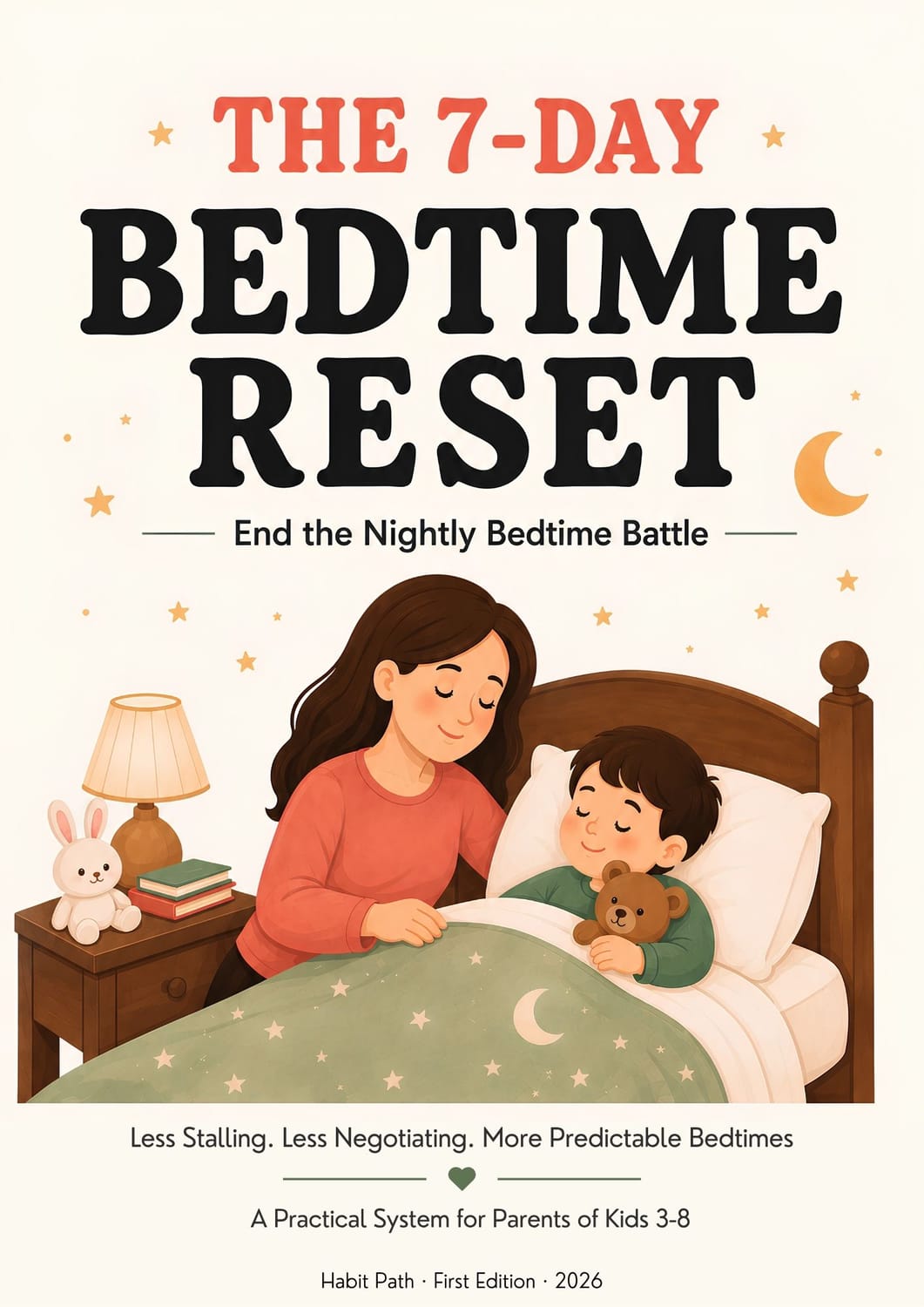
Bedtime shouldn't feel like a hostage negotiation.
Every night, the same script plays out — and every night, it drains a little more out of you.
The stalling
One more book. One more sip of water. One more hug. Each "one more" buys ten minutes, and the requests never actually end — they just reload.
The negotiating
Somehow a simple "time for bed" turns into a nightly debate with a very small lawyer — and you're losing cases you didn't know were on the docket.
The exhaustion
Bedtime lands at the exact hour your patience runs out. You've been "on" all day — and the hardest parenting moment is saved for when you have the least left.
The guilt
You snap, you raise your voice, the door finally closes — and then the guilt shows up. Tomorrow, you promise, will be calmer. Then tomorrow comes.
I just can't. And sadly, those are the nights my kids seem to want me most.— A parent
You're not doing this wrong.
Kids between 3 and 8 are wired to test edges — and they test hardest at the exact hour you have the least patience left to hold them. That's not a coincidence, and it's not a character flaw in you or your child. It's just terrible timing built into how young kids work.
So when bedtime falls apart, what's breaking isn't your love, and it isn't your effort. It's the absence of structure at the one hour of the day that needs it most.
A predictable sequence, plus short, consistent responses your child can see coming — that's what ends the battle. Not more patience. Not more willpower. Structure.
One night. One tool. Seven days.
No pile of tips to sort through alone. Each night adds a single layer, so by the end of the week the whole routine holds itself up.
Make bedtime predictable
A clear, repeatable bedtime sequence your child can see coming.
Stop the stalling
Fewer "one more thing" delays — without a fight over each one.
End the negotiation
Calm, consistent boundary responses that close the debate.
Get back in bed
One simple response to repeated exits — the same one, every time.
Reduce "I need you"
Gradual reduction of parent presence, one small step a night.
Handle the hard nights
A rescue plan for the evenings that go sideways anyway.
Make it stick
A one-page family bedtime blueprint, so the calm survives long after the week is over.
Three small moves, once a night.
Built for parents whose tank is empty by 7:45 PM. Nothing to study, nothing to memorize.
Read tonight's chapter
One short chapter — about 5 minutes. Just what you need for tonight, nothing more.
Use tonight's tool
Each night comes with one printable tool. Put it on the wall or the fridge and use it that same evening.
Jot what happened
A couple of words is enough. Tomorrow night adjusts to how tonight actually went.
Everything you need for the next 7 nights.
The 7-Day Bedtime Reset
Complete digital system · instant download
The 7-Day Bedtime Reset Workbook
The full night-by-night system: seven short chapters, one clear tool added per night, from the first predictable sequence to the family blueprint that makes it stick.
The Reference Tools Pack Bonus
All 7 printable tools, ready to stick on the wall the night you need them:
- Routine Card
- One-Week Stall Log
- Standoff Scripts
- Parent Calm Card
- Family Bedtime Blueprint
- Co-Parent Bedtime Plan
- Weekly Progress Tracker
Instant digital download · start tonight
You've probably already tried the free stuff.
| The 7-Day Bedtime Reset |
Free parenting blog posts |
Generic sleep books |
|
|---|---|---|---|
| Price | $17 | Free (plus hours of searching) | $15–$30 |
| Night-by-night plan | ✓ One tool per night | ✗ Scattered tips | ✗ Theory to adapt yourself |
| Printable tools included | ✓ 7 tools | ✗ | ✗ Rarely |
| Built for stalling & negotiating | ✓ That's the whole point | ✗ Generic advice | ✗ Mostly infant sleep |
| Ready to use the same night | ✓ Tonight | ✗ You assemble it | ✗ After 200 pages |
"Okay, but…"
"My child is too stubborn for this to work."
Good — the system doesn't run on your child's cooperation. It runs on structure you control: what the sequence is, and how you respond when it's tested. Stubborn kids don't break structure; they're actually the ones who settle fastest once the edges stop moving.
"We've tried routines before. They never stick."
Most routines collapse because everything changes at once — new rules, new chart, new bedtime, all on a Monday. This system adds one layer per night, so each piece has a chance to hold before the next one is added.
"I don't have time to read a whole book."
Neither do we, honestly. Each night is one short page — about 5 minutes — and you use it the same night. You're never more than one page ahead of tonight's bedtime.
Bedtime stopped being a fight.
“Bedtime was taking almost two hours every night.”
We already had the same routine, but my 6-year-old would come out of her room over and over, asking for one more thing, one more question, one more cuddle. This gave me an actual response plan instead of repeating myself all night.— Parent of a 6-year-old
“The biggest change was stopping the negotiation.”
I realized I was explaining and explaining every time my son pushed back. Having a short script to repeat made bedtime feel so much calmer. I didn't have to invent a new answer every night.— Parent of a 5-year-old
“We were stuck in the ‘one more thing’ cycle.”
Water. Bathroom. Another story. Another question. Another hug. By the time my child was finally in bed, I was completely exhausted. The 7-day system helped us make the routine predictable and stop reopening it.— Parent of a 4-year-old
“I thought our bedtime routine was already good.”
We had the routine, but the problem was everything that happened after the routine. Getting out of bed, calling for me, asking me to stay… The part that helped most was finally having a plan for those moments.— Parent of a 7-year-old
“I stopped feeling like bedtime depended on my patience.”
Some nights I was calm, other nights I was completely done. The scripts and the Stay-in-Bed plan gave me something simple to follow when I was tired. That alone made a huge difference in how I handled bedtime.— Parent of a 6-year-old
“We didn't need a perfect bedtime. We needed a repeatable one.”
That was the biggest shift for us. Instead of trying to fix everything at once, we worked through one problem at a time. The routine became clearer, the arguments became shorter, and bedtime finally felt manageable again.— Parent of two young children
Before you ask…
Is this a PDF or a physical book?
My child is a different age — will this still work?
What if my child's sleep issues are more serious?
How is this different from other sleep guides?
Seven nights from now, bedtime can just be… bedtime.
Quiet house. Sleeping kid. And you, on the couch, with your evening back.
Instant digital PDF download · workbook + all 7 printable tools